
TORONTO, ONT.: On Oct. 22, Heart & Stroke released the latest five-year update to its
Canadian Guidelines for Cardiopulmonary Resuscitation (CPR) and Emergency Cardiovascular Care
(ECC).
Among the key updates is a renewed emphasis on lay responders providing rescue breaths when
performing CPR, especially for children and infants.
Approximately 60,000 out-of-hospital cardiac arrests happen in Canada in every year – that’s one every nine minutes.
Survival from out-of-hospital cardiac arrest in most communities is fewer than one in 10
people but doing CPR and using an automated external defibrillator (AED) can double the chance of
survival.
ADVERTISEMENT:
Providing rescue breaths (also referred to as ventilations) can be critical – especially for children and infants, as well as in cases of breathing-related cardiac arrest such as drowning, choking, and opioid-
associated emergencies.
“Children are not just small adults—their physiology and causes of cardiac arrest differ significantly,” says
Dr. Farhan Bhanji, Professor of Paediatrics, McGill University, who is involved in the new guidelines
through his work with both Heart & Stroke and the International Liaison Committee on Resuscitation
(ILCOR).
“Unlike adults, paediatric cardiac arrests often stem from respiratory issues, making oxygen
delivery through breaths essential to improving outcomes.”
The risk of cardiac arrest is higher among adults, and for lay responders doing CPR with chest
compressions only on adults can be life-saving.
ADVERTISEMENT:
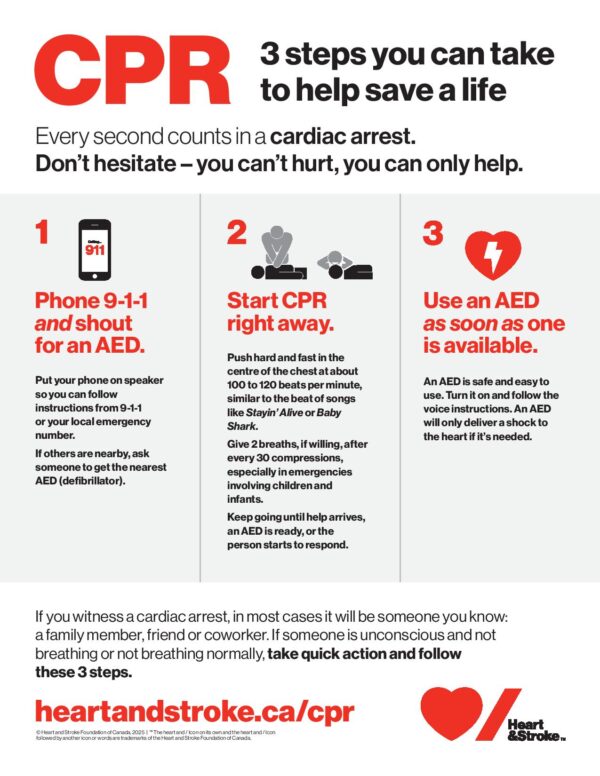
Anyone who witnesses a cardiac arrest should follow
these three steps:
- Call 9-1-1 and shout for an AED.
- Start CPR right away.
- Use an AED as soon as one is available.
Other notable updates to the new guidelines include: - 9-1-1 call takers providing instructions for rescue breaths as part of CPR instructions for children
and infants. - Implementing community initiatives and mass media campaigns to improve lay responder
response and promote CPR skills. - Gamified learning may be used to enhance engagement and skill retention.
- Starting CPR training in children younger than 12 years of age to increase willingness and self-
confidence in providing CPR in later years. - Reinforcing public access to naloxone and training lay responders on recognition and initial
treatment steps for victims of opioid-associated cardiac arrest. - Providing assessment and treatment for emotional distress for cardiac arrest survivors and their
caregivers. Approximately one in four cardiac arrest survivors and their care-givers experience
emotional distress.
ADVERTISEMENT:
Heart & Stroke is a founding member of and the only Canadian council representative on the International Liaison Committee on Resuscitation, which reviews resuscitation research and science to develop evidence-based treatment recommendations.
Heart & Stroke guidelines form the basis of all our
resuscitation training programs which are recognized as the gold standard in Canada. also form the basis
of all other resuscitation training programs offered by training organizations across Canada.
“Working closely with partners and stakeholders, Heart & Stroke is committed to advancing resuscitation,” says Doug Roth, CEO, Heart & Stroke.
“In addition to establishing and localizing the guidelines for Canada and embedding them in our resuscitation training programs, we are raising public awareness, increasing CPR skills and AED access, and funding life-saving research.”
Heart & Stroke wants all Canadians to recognize the signs of cardiac arrest and learn how to act quickly during an emergency.