
The following is a column from Rev. Michael Tutton.
A hug can be both verb and noun – at once an action one person undertakes and also the gift another receives.
During the pandemic the public mood shifted against hugs, and understandable caution remains. However, many of us missed them terribly, whether the informal hug after visiting a friend, or those offered more formally when congregations “pass the peace.”
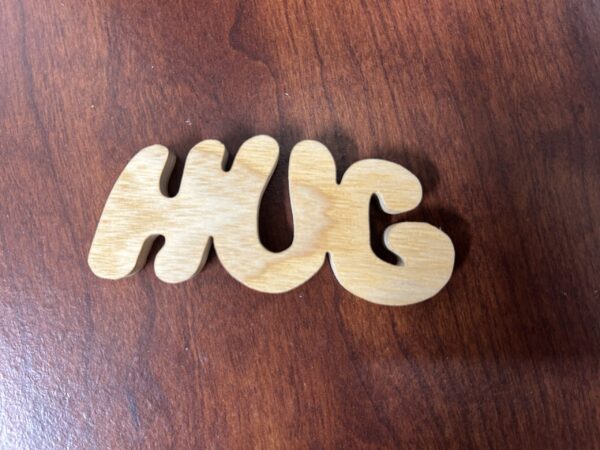
During the 2020 pandemic, John Manthorne met, through his wife Nina Manthorne, a friend who received a hug made from wood.
The 80-year-old amateur woodworkerfrom Wellington, N.S.,started making the curvaceous hugs himself, using his scroll saw and dipping them in Danish oil.
In the past six years he’s made about 14,000, allowing the natural grains of oak, maple and ash to give each a distinctive character.
I learned about this when Nina was introducing herself at a prayer shawl ministry, as she gave my wife and I one of John’s hugs. She explained how we can receive the hug and then pass it to another person, offering a physical hug if desired. Mine has recently gone on to a grieving young woman.
They’re not meant to be stored or put away in a closet, but rather passed on or put in a place others can view them.
Nina’s knitting of prayer shawls is her way of creating a similar sentiment. Like physical arms, the woven wool goes around a sad or grieving person. In my experience as a priest, there is an immediate moment of “hug-like” intimacy and openness when this wrapping around occurs, and often it’s followed by a time of spoken and shared prayer.
It reminds me that as this is being written we’re in the season of Lent, which began with the smearing of ashy crosses on foreheads on Wednesday, February 18th.
On that day, many churches read from the second chapter of the prophet Joel, who tells a sinful population that God doesn’t desire surface signs of repentance, but rather that we “rend our hearts” towards Him.
There is a deep desire of this God to not have a distanced relationship, but one that is intimate and embracing. Joel cries out that God’s nature is compassionate and gracious, “slow to anger” and abounding in steadfast love.” (Joel 2.13)
A few days after reading these words, I was working with Cheryl Borden and her family as they prepared the funeral for her husband Bob Borden. As we organized the liturgy for the gathering, she mentioned she’d like to tell her own story of how she received one of John Manthorne’s hugs.
The day before he died from heart failure, Bob Borden had received one of the wooden hugs as the retired mechanical engineer was out walking his dogs. He returned home and presented his wife with the hug and then – as Cheryl told mourners – bashfully wrapped his arms around her.
Now, the wooden hug is a treasured memory and a moment to return to amidst grief. John and Nina came to the funeral and provided about 20 more hugs. Cheryl has distributed them to her family since then.
Though Lent is sometimes rightfully thought to be a time to ponder our own brokenness, it can also be a period to imagine a world where small acts of kindness multiply and change our broken world.
This isn’t to say that John’s 14,000 carved hugs or Nina’s prayer shawls will themselves stop bombs and ballistic missiles reigning down in war zones.
They also haven’t yet ended degenerative illnesses or stopped the human conditions of folly and false pride.
But then again, who knows what might come from a heart that is lifted in a moment when a stranger comes before them and offers a wooden hug, or a pastor drops off the shawl knitted by loving hands?
Who knows how that person might be inspired to do the same thing, one day?
Might a young man or woman feel hope restored, and more fully devote themselves to working on medical research or visiting a lonely neighbour?
Might it inspire us to send money to a development agency that will help rebuild the communities torn apart by wars?
Perhaps the humble hug can take on new forms as they multiply, landing places never anticipated.
The possibilities of expanding the concept are endless: Gleaming hugs crafted by metal workers, golden hugs fashioned by jewelers, digital hugs replicated on social media.
And yet, above all, the simple and desired hug of one person to another remains at the core of it all.
“We’ve been on bus trips over the past six years, and these hugs have gone all through the world,” said Nina.
Rev. Michael Tutton is a former national journalist who now works as an Anglican priest in the Parish of Fall River and Oakfield.